

There are certain words every football coach dreads, and “pubalgia” is definitely one of them. When a player starts complaining about groin pain, the first reaction is often: “Let’s hope it goes away with some rest.” But here’s the problem: groin pain isn’t just a minor nuisance, it doesn’t go away with rest, and most importantly, it’s not always the same thing.
Under the label of “pubalgia” lie multiple conditions—some related to muscular overload, others to joint issues or even nerve problems. There can be many different causes of groin pain! The risk, then, is lumping everything into a single category and mismanaging the recovery process.
The Coach’s Key Role: Stop, Ask, and Listen
The coach is primarily responsible for the health of their players. When a player reports groin pain, it’s the coach’s job to help ensure a proper diagnosis is made. Without a specialist medical evaluation, the risk of mismanaging the recovery process is extremely high.
Why?
- Not all groin pain is the same. It can stem from muscle-tendon overload (such as the adductors, rectus abdominis, or iliopsoas), hip joint or bone issues, or even inguinal hernias. Without a proper diagnosis, there’s a risk of treating the wrong area or not being specific enough in the approach.
- Complete rest is not the solution. The pain may subside, but if the underlying causes aren’t addressed, the problem will return once the player is back on the field.
- Forcing a return by “playing through the pain” is a mistake. Recovery must follow a specific path based on functional milestones, not the team’s schedule.
The solution? Targeted and personalized therapeutic exercise
Often, the issue involves chronic overload of the adductors (adductor-related Groin Pain). For this type of groin pain, there are scientifically validated protocols designed to reduce pain and prevent future episodes. The most well-known is the Adductor Strengthening Protocol, also referred to as the “Copenhagen Protocol,” which has been proven to significantly reduce the risk of injury in athletes.
The 2019 scientific paper by Harøy and colleagues is freely available for download here:
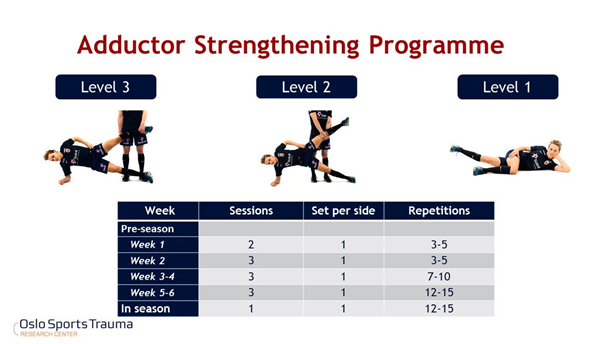
Here’s an example of an exercise from the Copenhagen Protocol:
However, this type of exercise must be introduced at the right stage of recovery and under the guidance of a professional. If performed too early or with excessive load, they can actually worsen the condition.
The team doctor and the football coach are allies in safeguarding the players’ health.
It’s not the coach’s role to decide when a player can return to the field after an acute or chronic injury. A progressive and structured approach is essential—one that begins with a medical diagnosis, continues with active rehabilitation under the physiotherapist’s guidance and medical supervision, and ends only when the player is truly ready and receives the final “green light” during a medical check-up.
What should a coach do?
✅ Report the issue to the team doctor immediately and never minimize the pain.
✅ Rely on professionals for both diagnosis and the recovery plan.
✅ Ensure a gradual, controlled, and stress-free return—without rushing it for team needs.
Groin pain doesn’t mean stopping forever—it means stopping at the right time to come back stronger. A healthy player is one who can give their best: prevention and smart recovery are the true keys to success.
Those who manage these issues well reduce the risk of recurrence and keep their players on the field longer.


