Focused Shock Waves (Focused Shock Wave Therapy, FSWT) are now a well-established reality in clinical practice within sports medicine and rehabilitation. The growing interest in this modality is not driven by therapeutic trends, but by a steady increase in scientific evidence supporting its effectiveness in specific musculoskeletal conditions, particularly chronic cases that are resistant to traditional conservative treatments.
For the clinician who works daily with athletic and physically active patients, FSWT represents an advanced therapeutic tool that can be rationally integrated between conventional physiotherapy and surgical options within a modern, comprehensive rehabilitation pathway.
Characteristics of Focused Shock Waves
Focused shock waves are high-energy acoustic waves characterized by a rapid rise in pressure followed by a negative pressure phase. Unlike radial shock waves, FSWT allows energy to be concentrated at a precise focal point, even at significant depths, enabling the selective treatment of deep musculoskeletal structures such as tendons, entheses, and bone tissue.
From a biological standpoint, the therapeutic effect is not purely analgesic but is based on the activation of a cascade of cellular and tissue responses, including mechanotransduction, increased expression of growth factors, neoangiogenesis, and modulation of the nociceptive response. These processes explain the progressive clinical improvement observed in the weeks following treatment.
Patient Indications: Selection Criteria
Appropriate patient selection is the key determinant of clinical success with FSWT. Available evidence indicates that the best outcomes are achieved in patients with chronic musculoskeletal disorders, typically with symptoms persisting for more than 3–6 months.
Another fundamental criterion is the failure of an adequate initial conservative treatment program, including relative rest, physiotherapy, therapeutic exercise, and, when indicated, pharmacological management. In this context, focused shock wave therapy offers an advanced treatment option before considering invasive approaches.
The diagnostic assessment must be accurate and supported by imaging. Musculoskeletal ultrasound plays a central role in confirming the diagnosis, evaluating structural alterations, and precisely guiding treatment. Magnetic resonance imaging is indicated in more complex or uncertain cases.
Clinical Indications
The clinical indications for Focused Shock Wave Therapy with the strongest scientific support include: chronic tendinopathies (Achilles tendon, patellar tendon, epicondylitis, rotator cuff); chronic plantar fasciitis, with or without calcaneal spur; tendon calcifications, particularly of the shoulder; delayed bone union and non-union.
In sports medicine, FSWT is particularly useful in treating functional overload conditions, provided it is integrated into a program that includes load management and correction of predisposing biomechanical factors.

Technical Considerations: Importance of Execution and Ultrasound Targeting
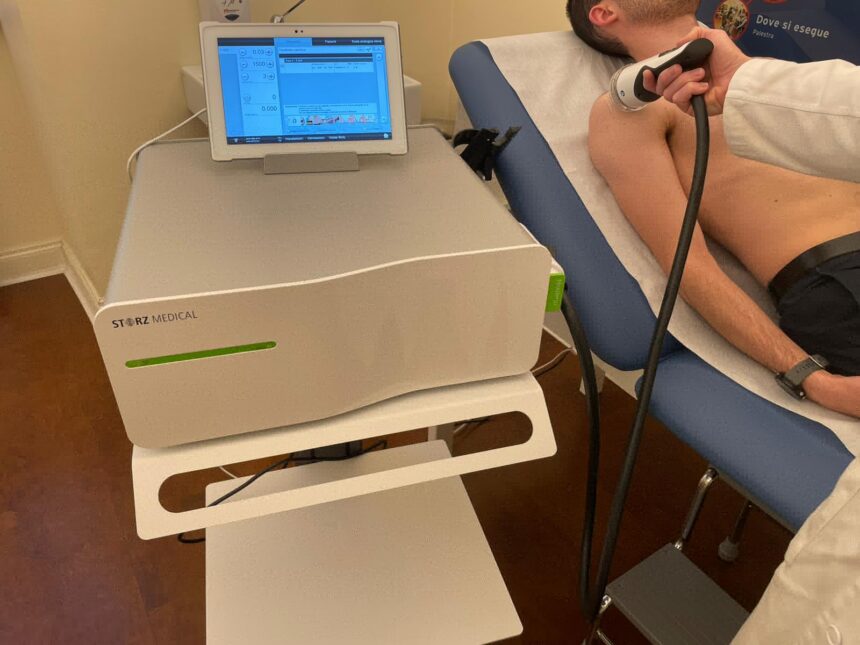
An often underestimated yet clinically crucial aspect concerns how Focused Shock Wave Therapy is performed. Both scientific evidence and clinical experience agree that the effectiveness of FSWT depends not only on the choice of the technique itself, but also on the precision with which the therapeutic target and treatment depth are identified.
Ultrasound targeting allows an accurate assessment of pathological structures, making it possible to identify the area of greatest structural alteration or maximum clinical sensitivity and to precisely estimate the depth of the tissue to be treated. This approach enhances energy focusing, reduces treatment dispersion, and increases the likelihood of achieving an adequate biological response.
The integration of musculoskeletal ultrasound into clinical FSWT practice therefore represents a significant added value, particularly in complex or deep conditions, and helps make treatment more targeted, reproducible, and consistent with a modern, personalized approach to rehabilitation.
Advantages Over Other Conservative Therapies
When compared with other conservative therapies, the added value of Focused Shock Wave Therapy lies mainly in its mechanism of action. Unlike corticosteroid injections, which are often effective in the short term but associated with a high rate of recurrence, FSWT stimulates biological processes of tissue repair and adaptation, leading to more stable results in the medium to long term.
Compared with traditional physical modalities (ultrasound, laser therapy, TENS), focused shock waves have a stronger pathophysiological rationale and a higher level of evidence for well-defined indications. Moreover, the ability to concentrate energy at depth allows treatment of structures that are difficult to reach with other techniques.
Another aspect of particular interest, especially in sports medicine, is the reduced need for surgery. Several studies have shown that appropriate use of FSWT can delay or even avoid surgical intervention in selected patients while maintaining good levels of functional recovery.
Role of Therapeutic Exercise
Focused Shock Wave Therapy should not be considered a standalone treatment. On the contrary, its greatest effectiveness is achieved when integrated into an active rehabilitation program. Therapeutic exercise—particularly programs aimed at load control and functional improvement—represents an essential complement to FSWT.
Shock waves create a biological environment that promotes tissue regeneration, while exercise guides the functional remodeling of the treated tissue, reducing the risk of recurrence and improving clinical outcomes.
Focused Shock Waves now represent a therapy of high clinical value in the treatment of chronic musculoskeletal disorders.
Dr. Davide Bertinetto, Isokinetic Turin
Shock Wave Therapy at Isokinetic Turin
Focused Shock Wave Therapy now represents a treatment of high clinical value in managing chronic musculoskeletal disorders. Proper patient selection, supported by thorough clinical and instrumental assessment, is the essential prerequisite for achieving meaningful results.
When incorporated into a personalized rehabilitation program and combined with therapeutic exercise, FSWT offers clear advantages over other conservative treatments, representing an advanced and safe tool for clinicians working in sports medicine and rehabilitation.
Isokinetic Turin is located at Via delle Orfane, 20/E.
Essential Bibliography
- Wang CJ. An overview of shock wave therapy in musculoskeletal disorders. Chang Gung Med J. 2003;26:220–232.
- Speed C. A systematic review of shockwave therapies in soft tissue conditions. Br J Sports Med. 2014;48:1538–1542.
- Schmitz C et al. Efficacy and safety of extracorporeal shock wave therapy for orthopedic conditions: a systematic review. Orthop J Sports Med. 2015;3:232596711558618.
- ISMST Guidelines Committee. Guidelines for extracorporeal shock wave therapy. ISMST, latest edition.